The Shift Journal
Because culture, clarity, and influence start in the mirror.
Written by Fannie Austin, Founder and CEO of Austin Dynamics, The Shift Journal examines leadership, workplace culture, institutional systems, and the patterns that shape outcomes. Issues connect analysis with practical audits, a shift practice, and reflection prompts you can use in your own work.
Explore the archive below. Select an issue cover to read the original journal; multi-page issues open in order.

Current Issues.
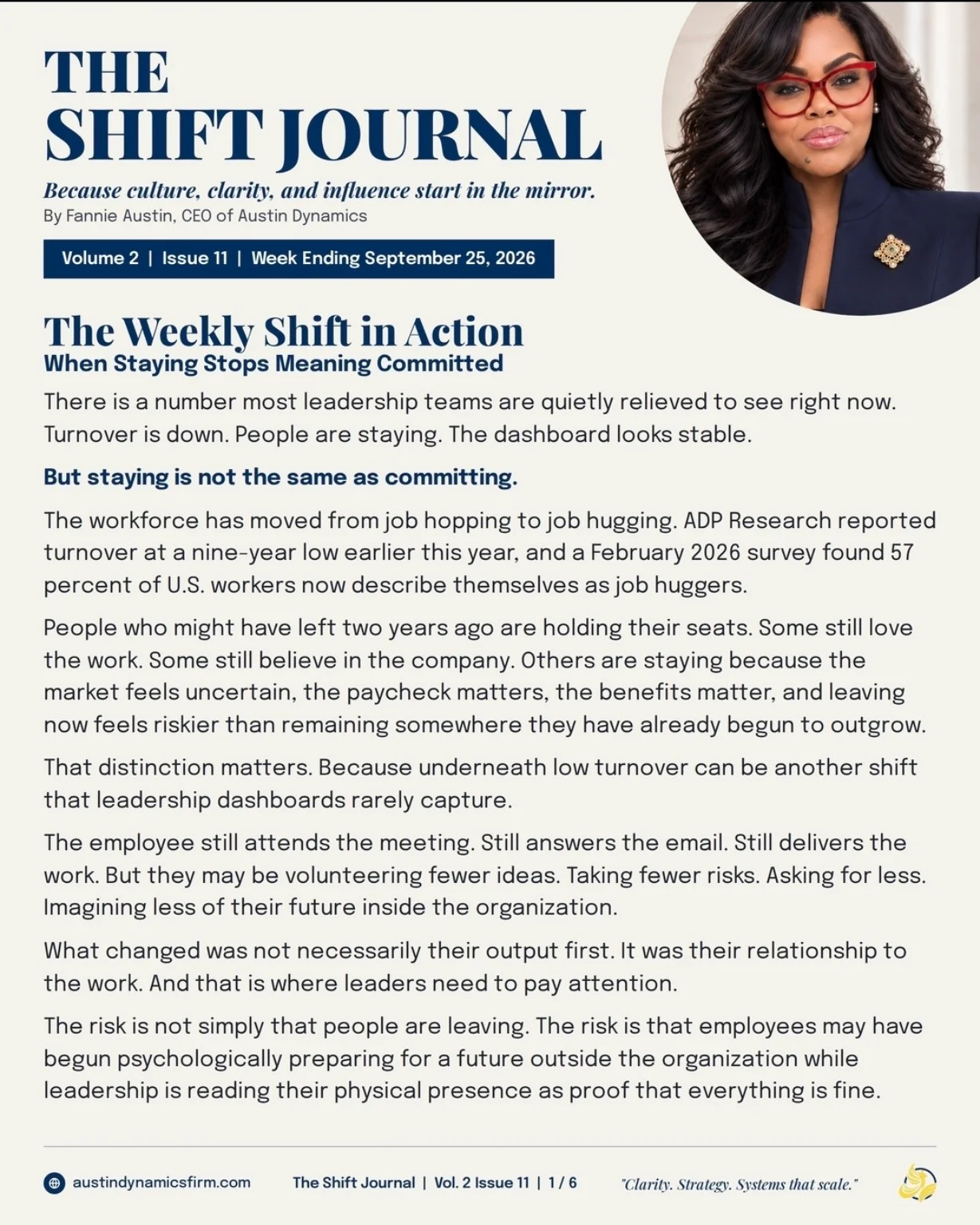
Vol. 2 | Issue 11 | Week Ending September 25, 2026
When Staying Stops Meaning Committed
This issue examines why lower turnover does not necessarily mean stronger commitment. Employees can keep their seats and deliver the work while curiosity, initiative, and investment in their future inside the organization quietly decline.
At its core is the distinction between retaining people and developing them. The Clarity Lens looks beyond attendance and tenure; the Leadership Mirror asks leaders to examine their own growth; and the Growth Hedge reframes outside learning as both organizational capability and career stewardship.
The central message: create an environment where growth has somewhere to go. The five-question Retention Signal Audit helps leaders examine exit risk, commitment, voice, employee growth, and their own development. The closing reflection asks what would make capable people continue choosing to grow here.
Complete six-page issue. Select the cover to read all six pages in order.
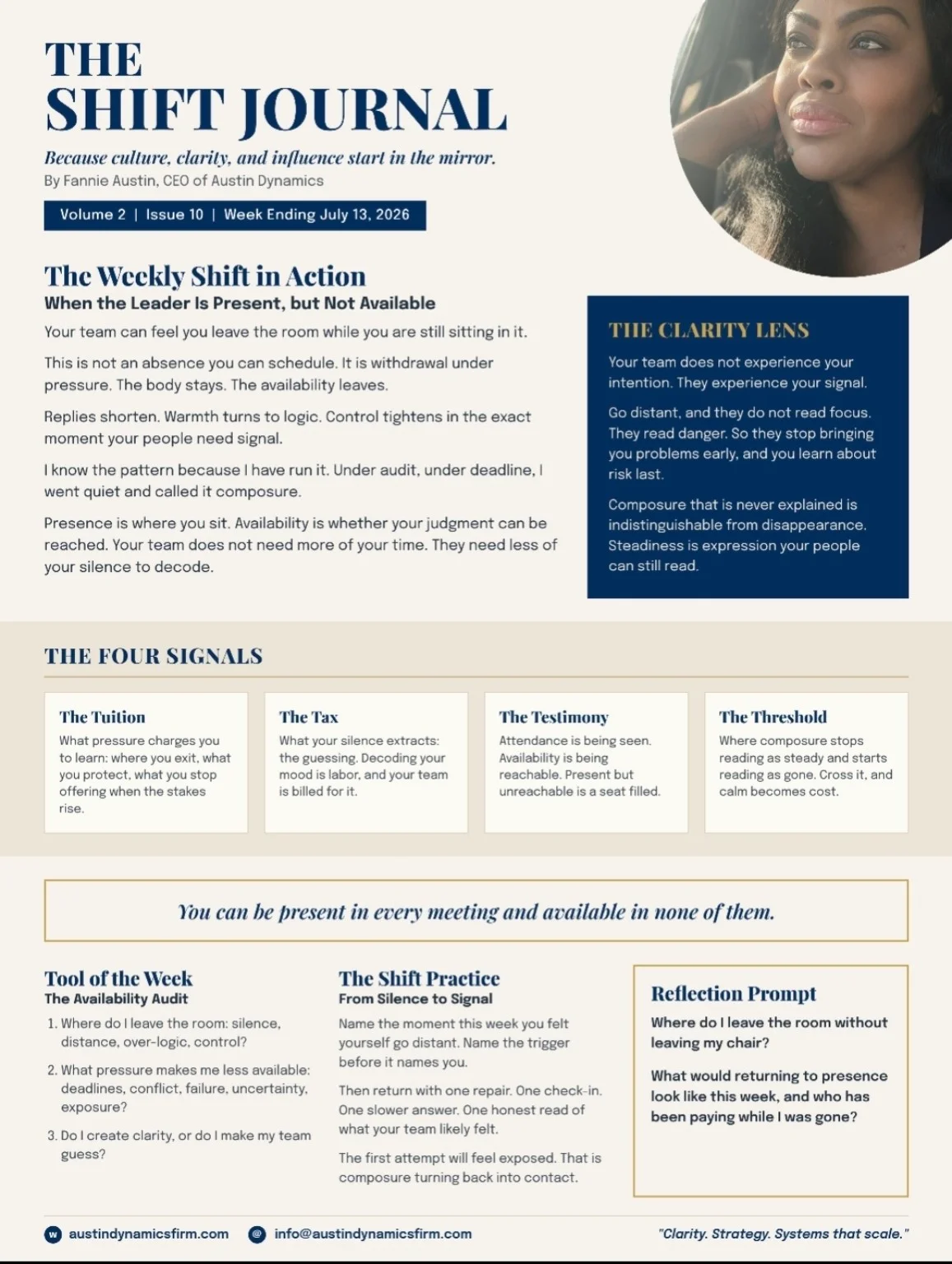
Vol. 2 | Issue 10 | Week Ending July 13, 2026
When the Leader Is Present, but Not Available
This issue examines the difference between occupying the room and remaining available to the people in it. Under pressure, silence, distance, over-logic, and control can look like composure to the leader while registering as danger to the team.
At its core is availability as a leadership responsibility. Teams experience the signal a leader gives, not the intention behind it. When they must decode withdrawal, problems arrive later and the cost of uncertainty falls on the people doing the work.
The central message: you can be present in every meeting and available in none of them. The Availability Audit and the shift from silence to signal help leaders return through a check-in, a slower answer, and an honest acknowledgment of what their team may have felt.
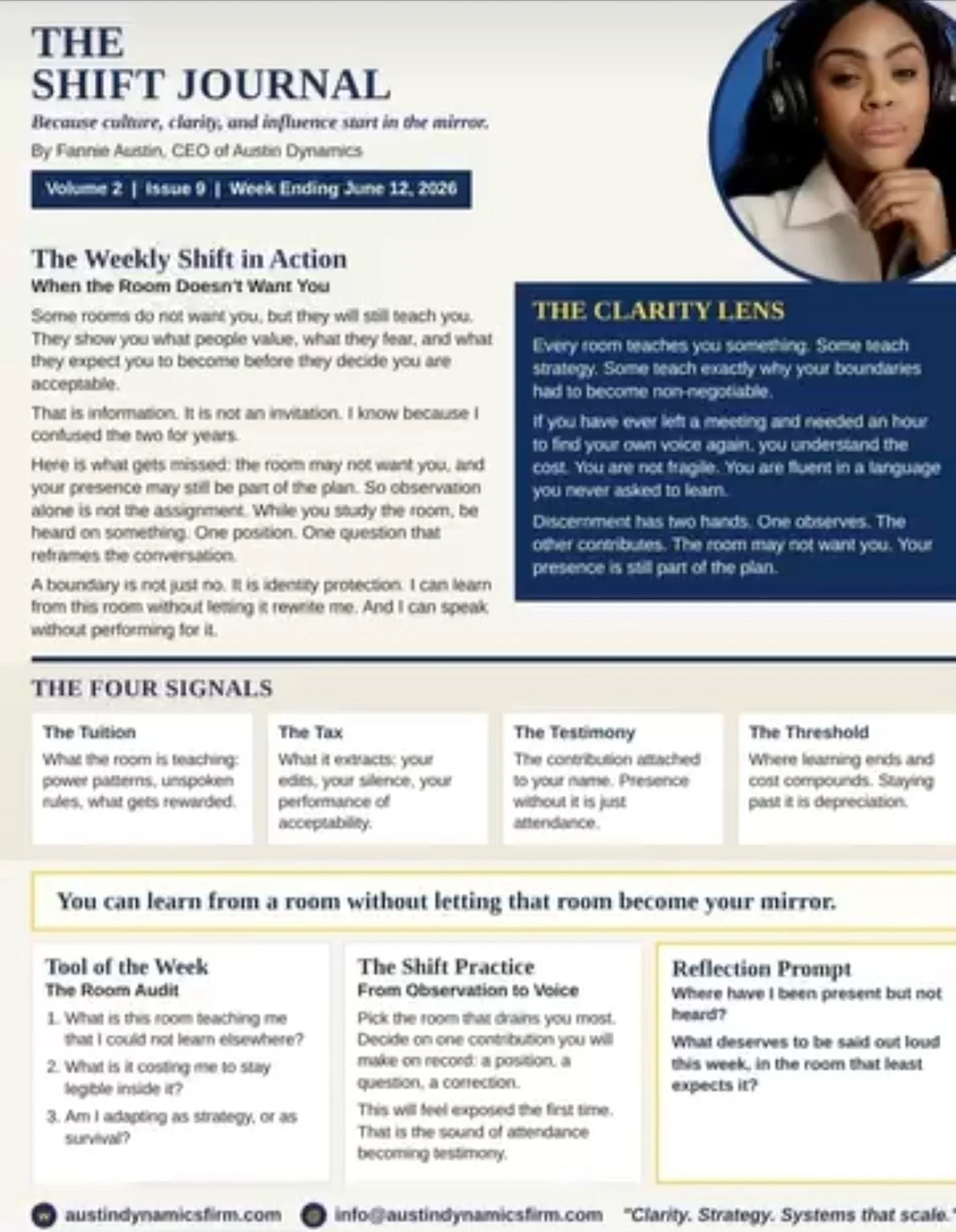
Vol. 2 | Issue 9 | Week Ending June 12, 2026
When the Room Doesn’t Want You
This issue examines what exclusion teaches, and what it costs to remain acceptable in a room that does not welcome your full voice. It treats observation as information, then asks what contribution deserves to be put on record.
At its core is the distinction between learning from a room and letting it rewrite your identity. The four signals, Tuition, Tax, Testimony, and Threshold, help leaders assess the room’s lessons, its demands, their contribution, and the point at which staying stops serving growth.
The central message: you can learn from a room without letting that room become your mirror. The Room Audit and the shift from observation to voice turn discernment into a concrete position, question, or correction.
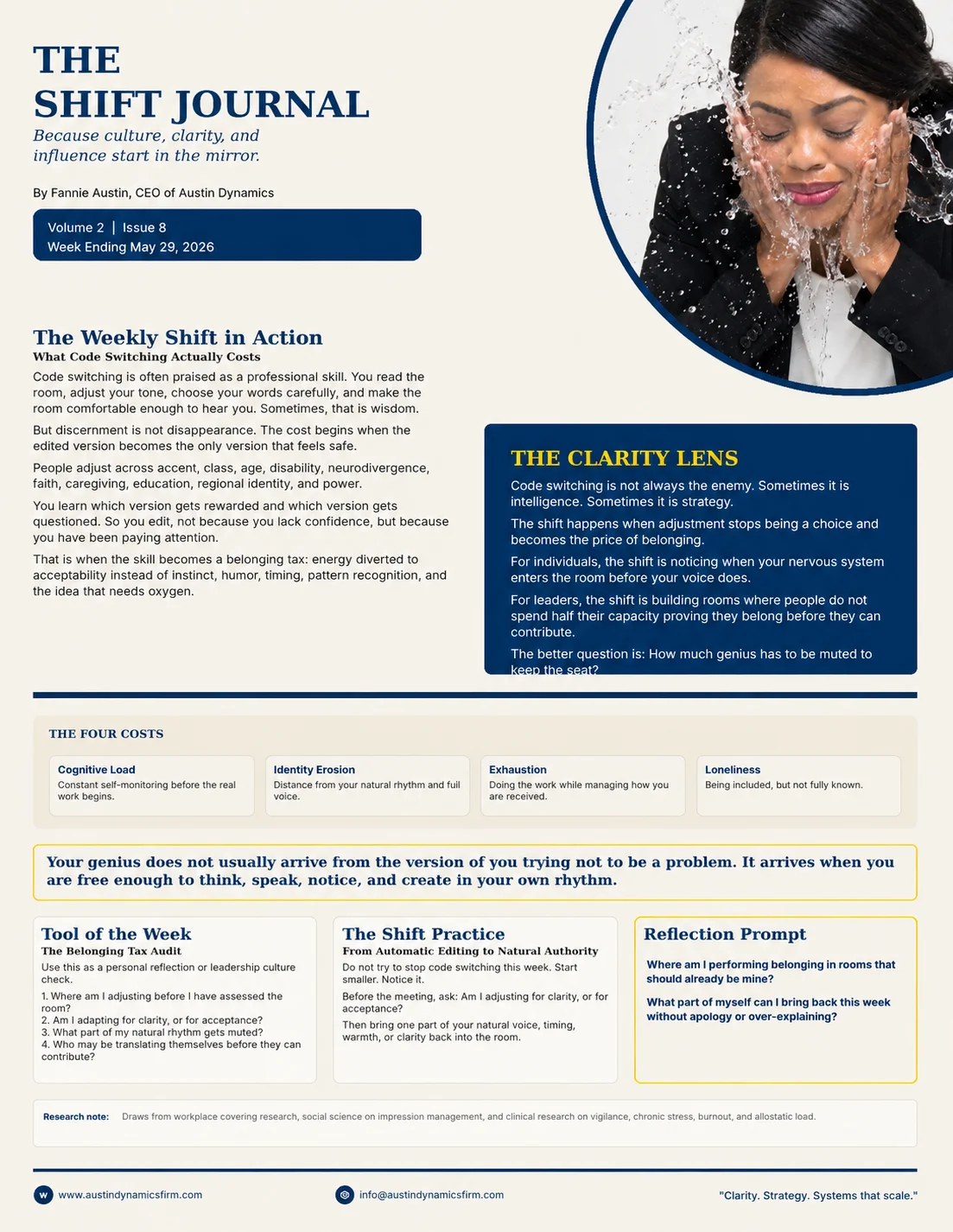
Vol. 2 | Issue 8 | Week Ending May 29, 2026
What Code Switching Actually Costs
This issue examines the hidden cost of code switching in the workplace, not simply as a communication skill, but as a form of identity labor that affects belonging, creativity, leadership capacity, and performance. It explores how professionals adjust their tone, language, presence, and emotional expression to be perceived as competent, safe, or acceptable in rooms where the rules are often unspoken.
At its core, this newsletter distinguishes discernment from disappearance. It challenges the idea that constant adaptation is always maturity or professionalism, showing how the pressure to be acceptable can quietly tax cognitive energy, identity, emotional stamina, and access to original thinking. Drawing from workplace covering research, impression management, and clinical research on vigilance, chronic stress, burnout, and allostatic load, the issue reframes code switching as a leadership and capacity issue.
The central message: code switching may help people survive a room, but it should not require them to mute their genius to keep their seat. Real inclusion is not just access to the table. It is the ability to think, speak, notice, and create without being edited by fear.

Vol. 2 | Issue 7 | Week Ending May 5, 2026
When Merit Becomes Familiarity
This issue examines the hidden ways organizations confuse familiarity with merit. It challenges the assumption that hiring, promotion, and recognition systems are always objective, arguing that many institutions reward what already feels recognizable, trusted, or culturally comfortable rather than what is most qualified or capable.
At its core, this newsletter is about operational integrity in decision-making. It explores how “merit” becomes distorted when evaluation systems are shaped by proximity, pedigree, communication style, or institutional habit instead of measurable outcomes. The issue reframes the conversation away from politics or optics and toward the structural quality of how organizations recognize talent.
The central message: merit is only real if the system can consistently detect it beyond its preferred patterns. When institutions mistake familiarity for qualification, they narrow innovation, weaken decision quality, and quietly reproduce the same rooms over and over again.
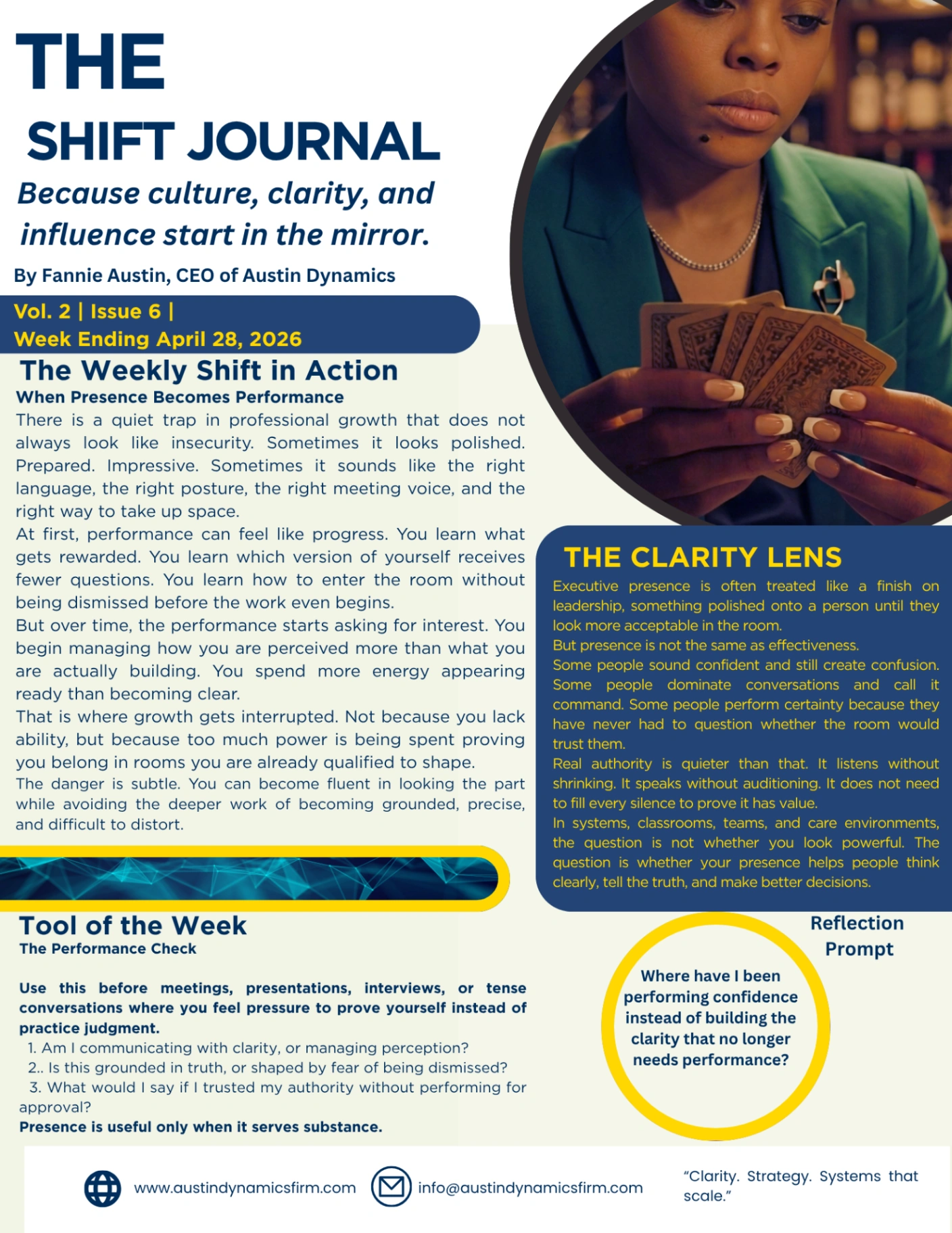
Vol. 2 | Issue 6 | Week Ending April 28, 2026
When Presence Becomes Performance
This issue examines the subtle shift from authentic authority to performative leadership. It explores how, over time, leaders can begin optimizing for perception, sounding right, looking prepared, and managing how they are received, instead of staying anchored in clarity, truth, and decision-making.
At its core, this newsletter distinguishes presence from performance. It highlights how performance can initially feel like progress because it reduces friction and earns approval, but eventually it diverts energy away from substance. Leaders begin appearing ready instead of becoming clear, and growth stalls not from lack of ability, but from misdirected focus.
The central message: real authority does not require constant proof. It is grounded, precise, and difficult to distort. Leadership strengthens when presence serves substance, not when it replaces it.

Vol. 2 | Issue 5 | Week Ending April 17, 2026
The $4M Decision Made in Ninety Seconds This issue examines the hidden risk in AI-assisted decision-making, not the technology itself, but the erosion of human judgment around it. It centers on how fast, confident answers can create the illusion of clarity while quietly bypassing the deeper thinking required to validate them.
At its core, this newsletter draws a sharp line between speed and discernment. It highlights how leaders can begin to substitute AI output for their own reasoning, approving conclusions that sound complete but have not been pressure-tested. The issue reframes AI as a precision tool that amplifies whatever thinking it is given, strong or weak.
The central message: the risk is not that AI gets it wrong, it is that leaders stop asking what is missing. Authority in this next era belongs to those who interrogate the answer, challenge the framing, and maintain ownership of the thinking behind every decision.
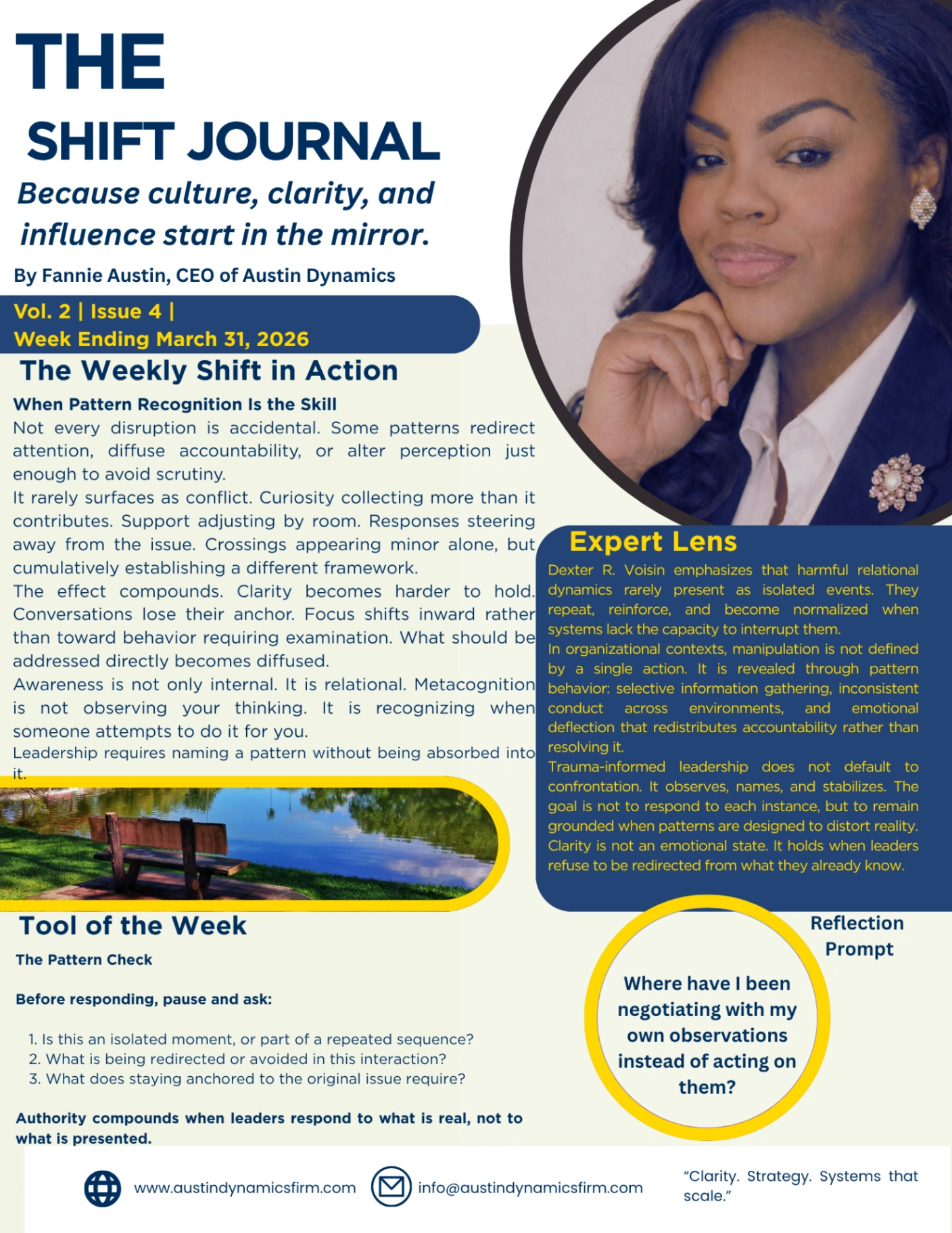
Vol. 2 | Issue 4 | Week Ending March 31, 2026
When Pattern Recognition Is the Skill This issue explores how leadership clarity depends on recognizing patterns, not reacting to isolated moments. It highlights how disruption often does not appear as conflict, but as subtle redirection, shifting focus, diffusing accountability, or altering perception just enough to avoid scrutiny.
At its core, this newsletter distinguishes events from patterns. It challenges leaders to stay anchored in what is consistently happening beneath the surface rather than being pulled into individual interactions that mask the larger issue. The issue emphasizes that awareness is not just internal reflection, it is relational, requiring leaders to notice when dynamics are shaping the narrative around them.
The central message: authority strengthens when leaders name patterns without being absorbed into them. Real influence comes from responding to what is actually happening over time, not just what is presented in the moment.

Vol. 2 | Issue 3 | Week Ending February 15, 2026
The Discipline of Watching Your Own Mind
This issue centers on metacognition, the discipline of examining your own thinking before acting from it. It explores how most leadership missteps do not begin with bad intent, but with unchecked assumptions, quick interpretations, or familiar stories that feel true because they are comfortable.
At its core, this newsletter distinguishes reaction from discernment. It challenges leaders to slow the move from perception to action and to question the meaning they are assigning to events. The issue argues that authority strengthens when leaders create space between stimulus and response, allowing evidence, context, and awareness to refine decision-making.
The central message: influence matures in the pause between thought and action. Leadership becomes steadier when the mind is not left unexamined, and when power is exercised from clarity rather than reflex.
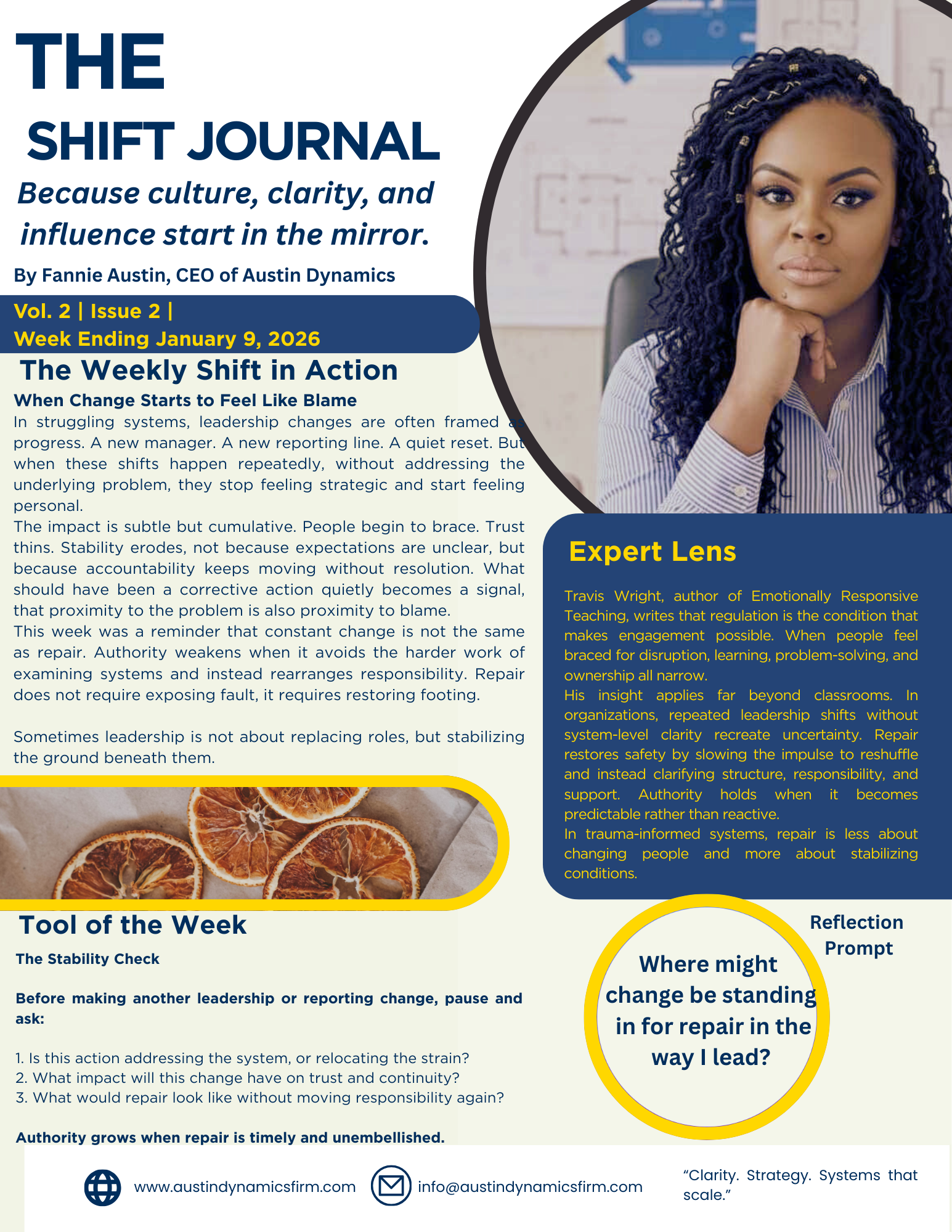
Vol. 2 | Issue 2
When Change Starts to Feel Like Blame
This issue examines the quiet erosion that happens when leadership relies on constant change instead of true repair. It explores how repeated shifts in managers, reporting lines, or roles can begin to feel personal when underlying system issues are left unresolved. What is framed as progress starts to register as blame, even when no one says it out loud.
At the center is the distinction between movement and stabilization. The issue argues that authority weakens when accountability keeps moving without closure, and trust thins when people feel reshuffled instead of supported. Rather than exposing fault or cycling responsibility, effective leadership restores footing by addressing structure, clarity, and continuity.
The core message: not all change is corrective. Sometimes leadership is not about replacing roles, but about stabilizing the ground beneath them so people can stand, engage, and take ownership without bracing for the next disruption.
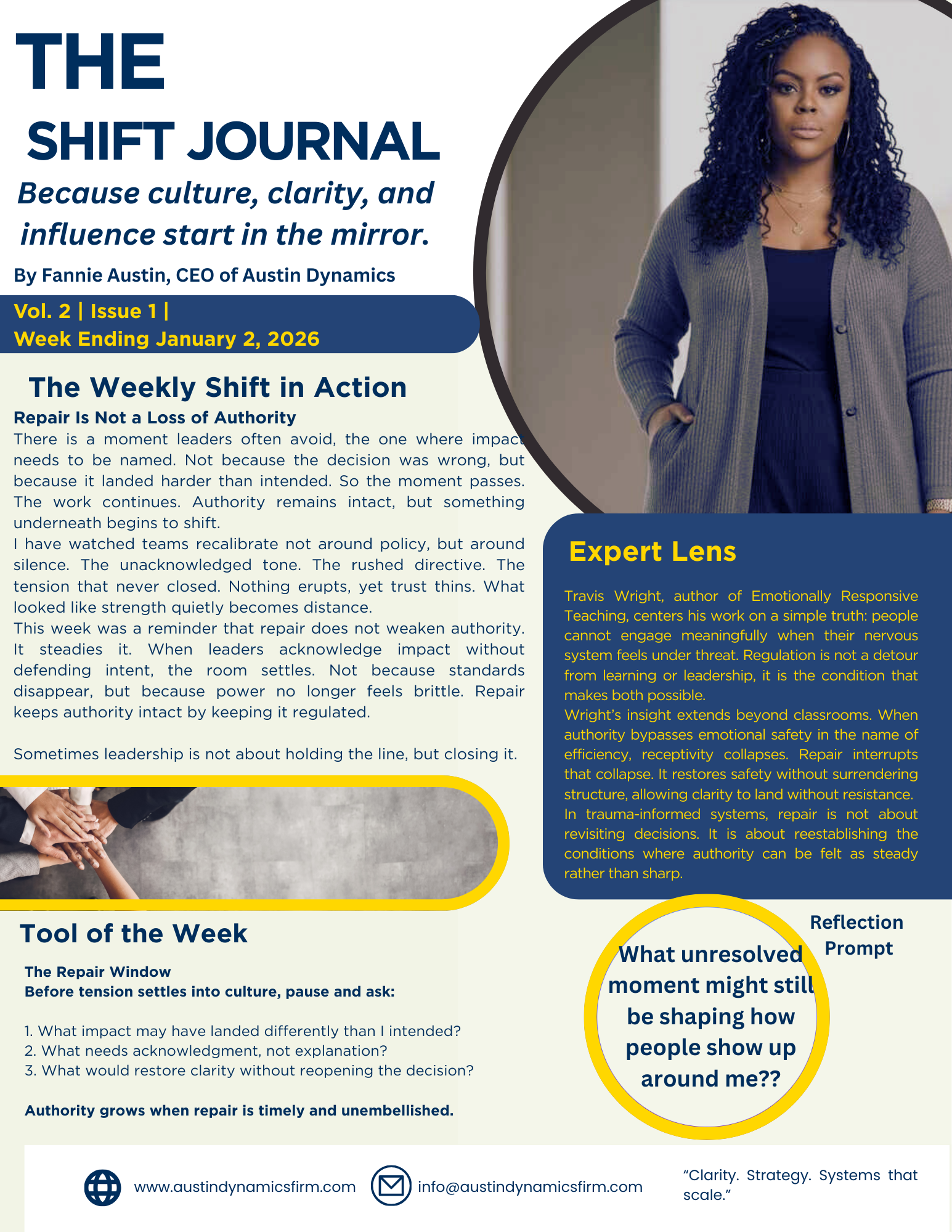
Vol. 2 | Issue 1
Repair Is Not a Loss of Authority
This issue reframes repair as a leadership strength, not a retreat. It focuses on the moments leaders often avoid, when a decision was correct, but the impact landed harder than intended. Rather than revisiting decisions or defending intent, the issue emphasizes naming impact, closing emotional gaps, and restoring steadiness before tension calcifies into culture.
At its core, this newsletter is about regulation as authority. It shows how unaddressed tone, rushed directives, and unresolved moments quietly erode trust, while timely repair stabilizes teams and allows clarity to land without resistance. Repair is positioned not as softness, but as a disciplined act that keeps authority intact, credible, and grounded.
The central message: leadership is not always about holding the line. Sometimes it is about closing it, so people can move forward without carrying unresolved weight.

Vol. 1 | Issue 1
Explore the power of pausing in leadership and communication.
This issue focuses on the importance of restraint in leadership, shifting conversations towards intention and trust.

Vol. 1 | Issue 2
Understanding the emotional impact of feedback for growth-oriented leadership.
This issue discusses how leaders can discern valuable feedback from bias and projection, maintaining confidence and integrity.

Vol. 1 | Issue 3
Addressing the gap between communication intent and reception.
Emphasizing the importance of considering tone, timing, and emotional context for effective communication.

Vol. 1 | Issue 4
Exploring belonging as a leadership responsibility.
Highlighting the role of attention, consistency, and recognition in creating inclusive environments.

Vol. 1 | Issue 5
Unpacking the hidden toll of constant composure in leadership.
Examining the need for emotional awareness and self-care in sustainable leadership.

Vol. 1 | Issue 6
Distinguishing between niceness and kindness in leadership.
Encouraging leaders to prioritize accountability and truth with care for growth and harmony.

Vol. 1 | Issue 7
Examining the negative impact of blame in leadership.
Reframing accountability as a search for clarity and encouraging verification over assumptions.

Vol. 1 | Issue 8
I Can Do Hard Things
This issue focuses on resilience during pressure. It reminds leaders that difficulty is not failure, but evidence of responsibility, and that confidence grows when leaders stay present, grounded, and strength-focused during hard moments.

Vol. 1 | Issue 9
Do Unto Others, Lead Unto Others
This issue frames leadership as a mirror. It explores how the tone, patience, and standards leaders model are reflected back through team behavior, reinforcing that fairness and respect must be lived, not stated.
Vol. 1 | Issue 10
You Can Be Right Without Making It a Power Play
This issue explores the difference between conviction and dominance. It highlights how leaders can hold truth firmly without forcing agreement, preserving connection while maintaining authority.

Vol. 1 | Issue 11
When Communication Turns Into Noise
This issue addresses overexplaining and repetition as signs of discomfort rather than leadership. It emphasizes knowing when clarity has been achieved and trusting systems and accountability to carry the message forward.

Vol. 1 | Issue 12
You Can Be Right Without Making It a Power Play
This issue explores the difference between conviction and dominance. It highlights how leaders can hold truth firmly without forcing agreement, preserving connection while maintaining authority.
Ready to Think Differently About How Systems Work?
“Most people consume information. The Shift Journal is for the ones who study structure, track patterns, and build accordingly. If you are serious about how power moves and how institutions actually function, this is where that conversation lives.” - Fannie Austin, Founder, Austin Dynamics